Kin
A voice-powered platform that transforms spoken memories and recipes into crafted stories, allowing families to build a shareable digital archive by editing content conversationally with an AI agent.
🎙️ Project KIN: The Digital Hearth
Status: Lean Implementation | Last Updated: July 10, 2026
➡️ Want to check it out for yourself?
app.kinscribe.uk
01. Strategic Discovery | The “Why” & “Who”
Mission: To eliminate the “friction of documentation” so that family legacies are never lost to time or tech-fatigue. Vision: To become the world’s most invisible archive—where oral history becomes a permanent family asset without a single “Sign Up” button.
🎯 The Market Thesis
- The “Longevity Economy”: Aging populations have a deep desire to be remembered, but a high resistance to learning new software.
- The Tech Convergence: We are at the intersection of perfect Voice-to-Text (Whisper) and empathetic restyling (LLMs).
- The Competitive Gap: Most “Legacy” apps (Ancestry, StoryWorth) require manual typing or navigating complex dashboards. KIN meets users where they already live: the Inbox.
💡 “Preserving the past shouldn’t feel like a chore. It should feel like a conversation.”
02. Problem Synthesis | The “What”
The Insight: We initially thought we needed a mobile app. User conversations revealed that seniors find apps “noisy” and “fiddly.” However, they do know how to reply to an email and record a voice memo on their phone.
🔍 Emotional Friction Points
| Stakeholder | The Pain Point | The Emotional Cost |
|---|---|---|
| The Storyteller (Senior) | “I want to share, but writing is hard on my hands/eyes.” | Feeling forgotten; legacy is lost. |
| The Archivist (Child) | “I keep meaning to record Mom, but life gets in the way.” | Future guilt; loss of heritage. |
| The Tech Barrier | “I don’t want to manage another password.” | Abandonment of the tool. |
The Pivot: We shifted from “Build an App” to “Build a Workflow.”
03. Solution Ideation | The “How”
Before settling on the n8n-powered email workflow, we explored three distinct paths:
- Option A: The Dedicated App. (Rejected: Too much friction, high acquisition cost).
- Option B: The WhatsApp Bot. (Rejected: Privacy concerns for seniors; too ephemeral).
- Option C: The “Ghost” Workflow (Email + Voice). (Selected: Low friction, utilizes existing behavior, creates a “living” paper trail).
💡 Why KIN Wins
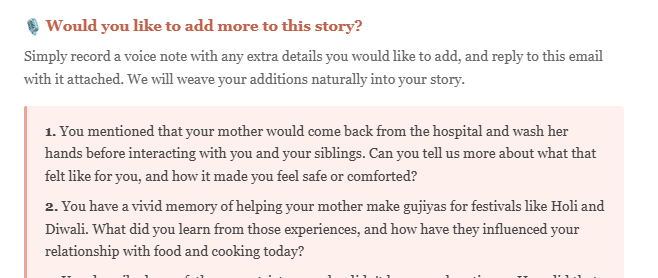
Instead of a blank page, KIN sends a weekly prompt via email. The user simply hits Reply, records a Voice Note, and hits Send. The “Magic” happens in the background.
04. Lean Implementation | The “Start”
We are currently in the Lean Implementation phase, using a robust n8n workflow to handle the heavy lifting.
⚙️ The Technical Architecture (Kin-Main-Workflow.json) (https://github.com/szkolnik/kin)
The system is built to be a “Zero-UI” product.
- Trigger:
New Voice Recording Emailvia Gmail. - Processing: * Whisper AI: Transcribes the raw audio file.
- GPT-4o-mini: Categorizes the content. Is it a Memory or a Recipe?
- Restyling Engine: The AI rewrites the transcript into a “Cinematic Story” or a “Formatted Recipe Card.”
- Output: * The Archive: Sent back to the family via email.
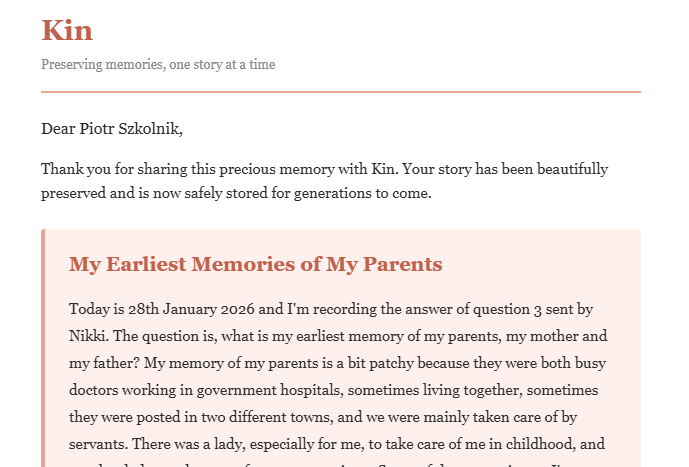
- The Visuals: (Ref: Screenshots) High-quality, readable layouts like “A Taste of Heritage” and “Chronicles of Kin.”
Success Metric: Weekly Active Storytellers (Retention). If a user records for 3 weeks straight, the friction has been successfully removed.
🎨 Design
- Story Output: “Chronicles of Kin” — A warm, sepia-toned digital layout that feels like an old journal.
- Recipe Output: “A Taste of Heritage” — Clean, structured cards that preserve Grandma’s voice alongside the measurements.
05. Growth & Optimization | The “Scale”
The North Star: Total Minutes of Heritage Preserved.
🚀 Future Roadmap
- Growth Loops: Allow “The Archivist” (child) to reply to a story with a question, triggering a new prompt for “The Storyteller.”
- Multi-Media Enrichment: Integrating the
Restore Binarynode to allow users to attach an old photo that the AI “describes” and weaves into the story. - The Physical Bridge: At the end of a year, a “Generate Book” button that turns the email archive into a physical hardback.